


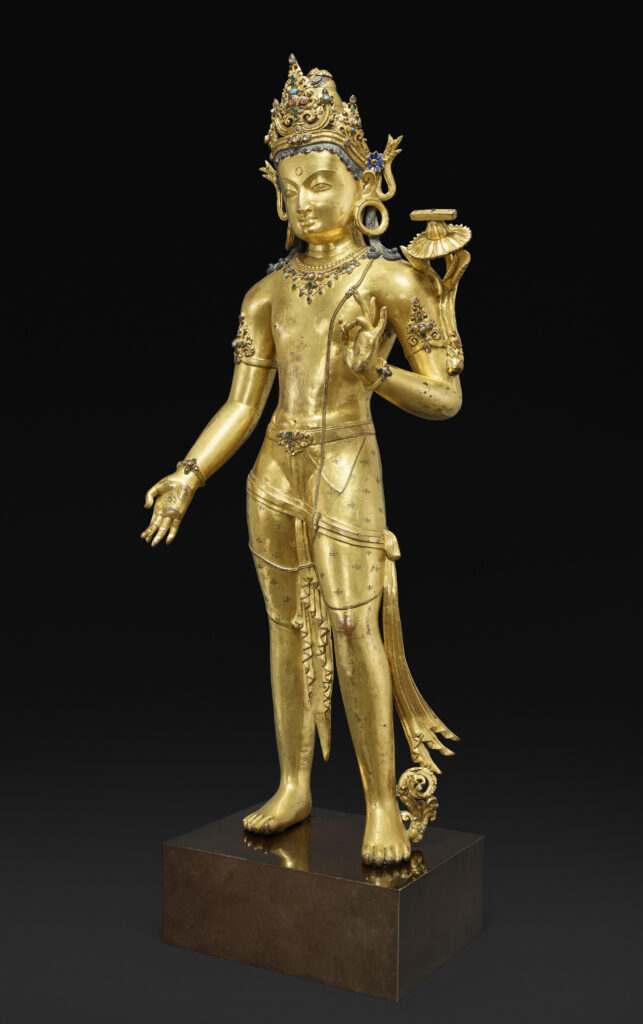
On 30 October 2026, a monumental 12th-century gilt-copper image of Manjushri sold at Christie’s Hong Kong for HK$137.35 million—approximately US$17.5 million. Offered in Awakening Wisdom: Masterpieces of Buddhist Art from a Private Asian Collection, the 93-centimetre sculpture set a world auction record for a Himalayan gilt-bronze sculpture. Its sale brought renewed attention to the artistry of Newar craftspeople and the Kathmandu Valley’s influence on Buddhist art across Asia.
Manjushri is the bodhisattva of transcendent wisdom. A lotus rises beside his shoulder, bearing the Prajnaparamita Sutra, associated with the perfection of wisdom. The figure’s presence comes from more than its scale. Crowned and richly adorned, it holds a poised stillness, while the body’s gentle curve gives it a sense of movement.
The Newar masterclass: form, grace and gilding
The sculpture’s stance is shaped by tribhanga, a three-bend posture that moves through the neck, torso and hips. The figure does not stand rigidly: its weight shifts subtly, creating a flowing silhouette. A slender waist, broad chest and relaxed hips give the body an elegant rhythm.
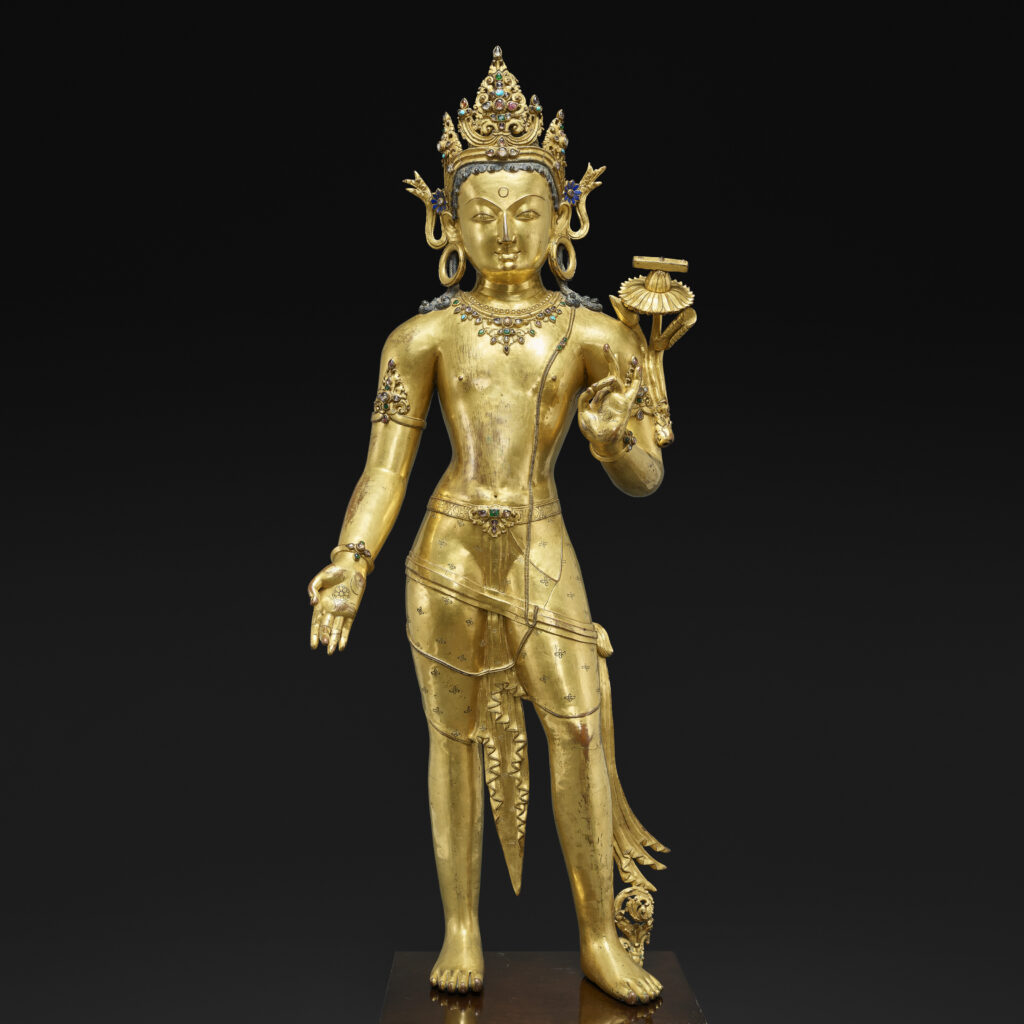
The three-quarter view shows the sculpture’s poised stance and finely modelled ornaments. Image: Christie’s Images Ltd.
That balance is central to the Newar aesthetic. Smooth planes of gilded copper sit alongside carefully worked necklaces, armlets, bracelets and sacred thread. Ornament enriches the figure without obscuring its shape. Its radiant surface would have caught the changing light of a shrine or temple interior. Christie’s identifies the sculpture as a rare work of the Newar tradition, distinguished by its scale, preservation and accomplished modelling.
The face and raised hand show the sculptor’s attention to detail: the composed expression, elaborate crown, and carefully formed gesture all contribute to the figure’s presence and meaning.
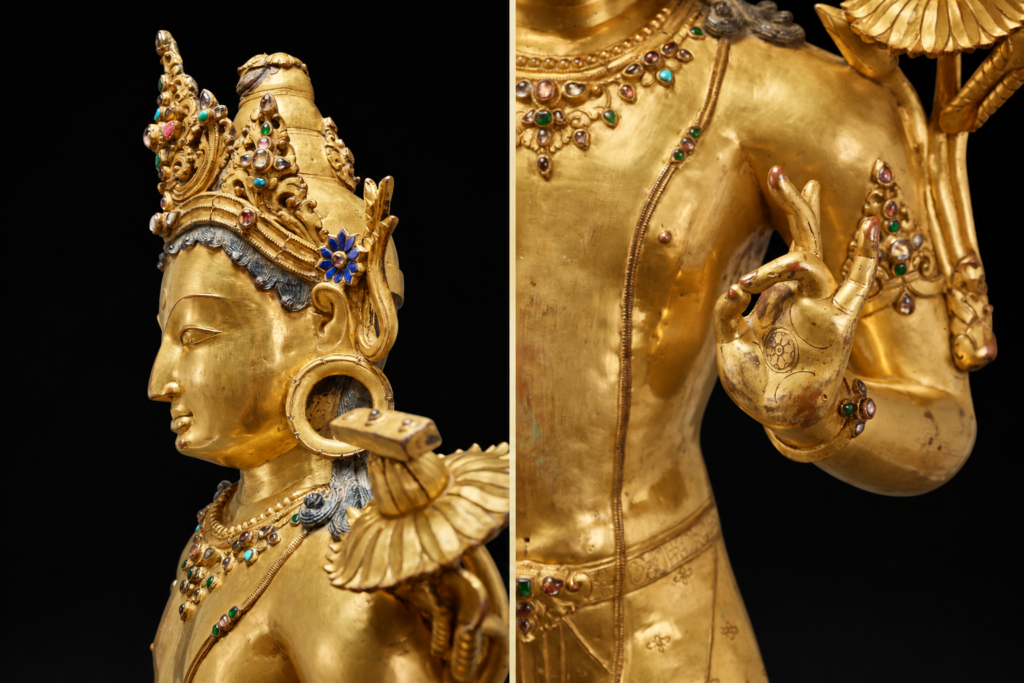
Close views reveal the crown’s intricate ornament, the calm expression and the precision of the hand gesture. Images: Christie’s Images Ltd.
From the Kathmandu Valley to Tibet
For centuries, Newar artists and metalworkers were among the Himalayan region’s most accomplished makers of Buddhist images. Their work joined inherited Indian forms with the Kathmandu Valley’s distinctive command of proportion, surface and ornament.
During the later spread of Buddhism into Tibet, artistic ideas and skilled makers travelled across the Himalayas. Newar influence became part of a broader visual culture associated with Tibetan Buddhist institutions, including the Jokhang, Sera and the Potala Palace. These centres developed over many generations, shaped by varied traditions and exchanges; Newar art formed one part of that wider story.
The Manjushri makes that exchange tangible. Its idealised body and refined ornaments give visible form to spiritual authority. Its beauty is not merely decorative: it helps express the wisdom the bodhisattva represents.
A legacy reaching imperial China
The movement of Himalayan artistic traditions continued further east. The Nepalese artist Anige, who worked under Yuan imperial patronage in the 13th century, is a prominent example of Newar artistic skill at an international court. Through artists, workshops and objects, Nepalese and Himalayan forms contributed to the exchange of Buddhist imagery across regions and dynasties.
The Manjushri predates Anige’s career, yet it shows the qualities that made Newar metalwork influential beyond the Kathmandu Valley: confident modelling, carefully composed jewellery and a luminous finish that bring technical skill and spiritual presence together.
Why the sculpture belongs to an elite corpus
Large, early gilt-copper bodhisattvas are exceptionally rare. Museums including the British Museum, the Victoria and Albert Museum and the Norton Simon Museum preserve important Nepalese or Nepalese-style standing bodhisattvas. Few comparable sculptures, however, combine such an early date with this scale and refinement.
The reverse view reveals another aspect of the work: the figure’s back, the fall of its drapery and variations in the aged gilded surface.
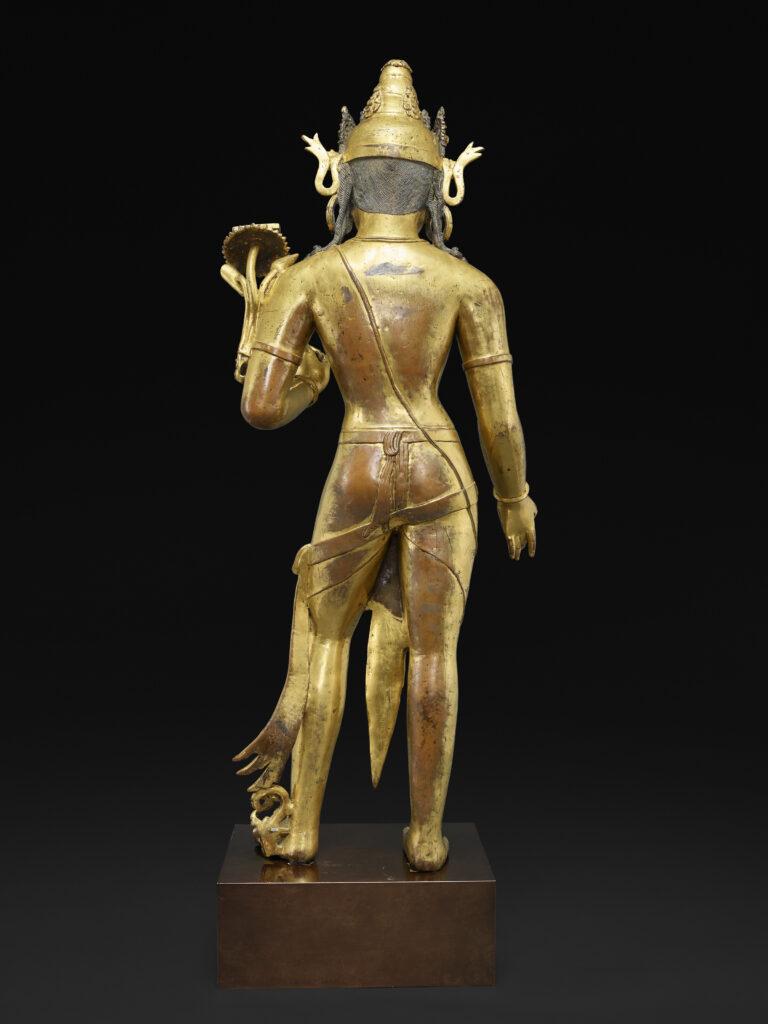
The reverse offers a different perspective on the sculpture’s form and surviving surface. Image: Christie’s Images Ltd.
The auction result reflects the sculpture’s importance to collectors, but its significance reaches beyond the art market. It is a devotional image, a work of remarkable metalcraft and a record of the Kathmandu Valley’s contribution to Buddhist art across Asia.
A living heritage
This Manjushri connects a 12th-century workshop in the Kathmandu Valley with Buddhist communities and artistic traditions across the Himalayas and beyond. Its record-setting sale is one moment in a much longer story of craft, faith and cultural exchange.
At The Himalayan Guides, we invite you to explore Nepal’s living heritage through its sacred architecture, historic cities and mountain cultures—and to experience the places where these traditions continue to resonate.